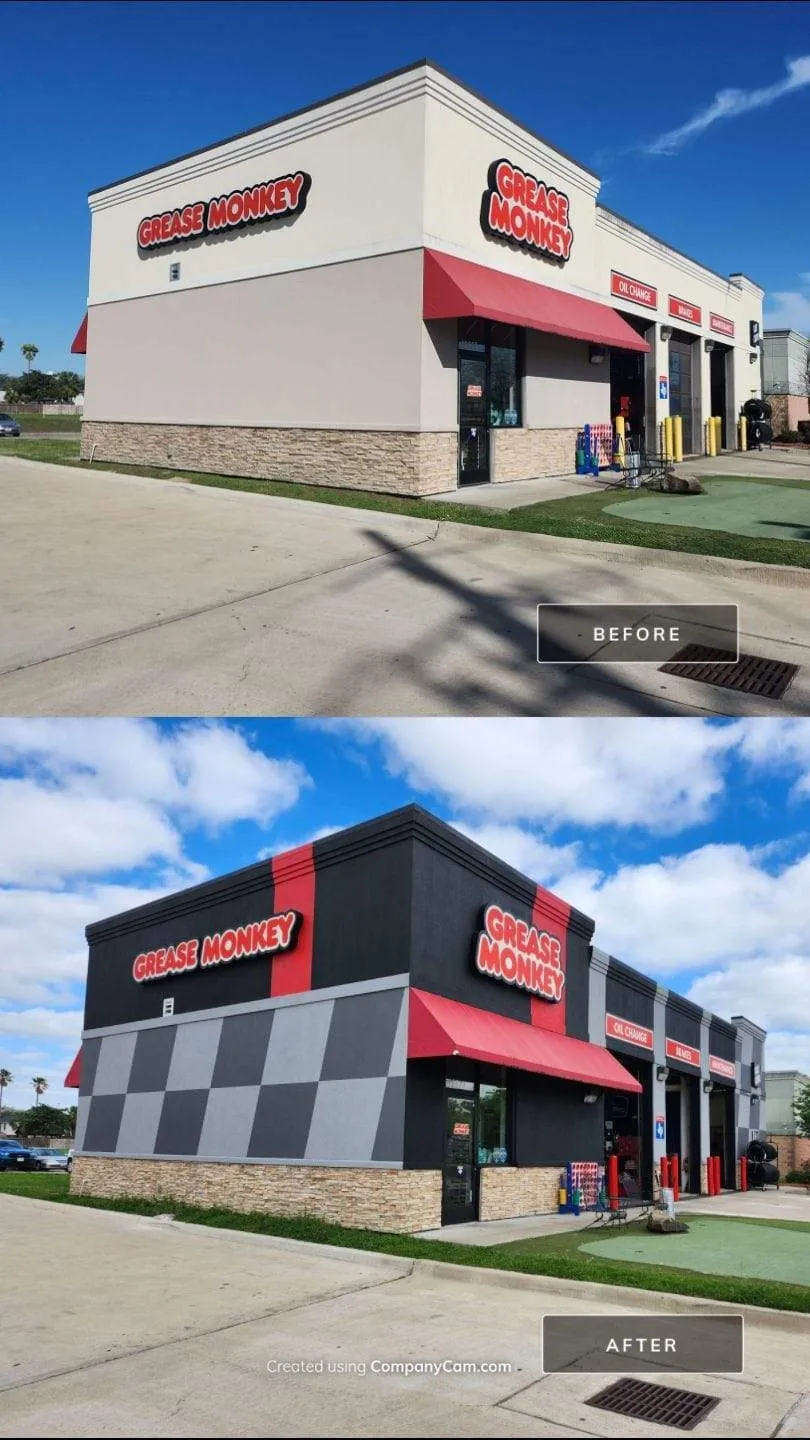
Commercial Building Repaint Schedule in The Woodlands, TX
Most commercial buildings in The Woodlands, TX need a full exterior repaint every 5 to 7 years, though that window can shrink to 3 to 5 years for south- and west-facing elevations, stucco surfaces exposed to heavy sun, or properties near the harsher wear of retail traffic. Interior common areas — lobbies, stairwells, restrooms — typically need a refresh every 3 to 5 years, while private offices and low-traffic interior space can often stretch closer to 7 to 10 years. There's no single number that fits every building, and treating a repaint cycle as a fixed calendar date instead of a condition-based decision is one of the most common mistakes property managers make.
I've spent more than two decades in this trade, and one thing holds true in every market: paint doesn't fail on a schedule, it fails based on exposure. A Class A office tower in Hughes Landing with glass and metal panel systems ages differently than a stucco retail strip along Market Street. Both age differently than a single-story professional building off Research Forest Drive. The guidance below gives you a realistic framework, not a one-size number.
Exterior vs. Interior vs. High-Traffic Common Areas
Exterior repaint cycles run longer than interior ones, but not by as much as most property managers assume once you factor in Gulf Coast humidity and sun load. A well-prepped, premium-coated exterior in The Woodlands, TX generally holds up 5 to 7 years before fading, chalking, or coating breakdown becomes visible. Interior common areas see far more physical contact — hands, carts, foot traffic, cleaning chemicals — so lobbies and restrooms in office and retail buildings tend to need attention every 3 to 5 years, while back-of-house offices and storage areas can often wait 7 to 10 years between coats.
Industrial and warehouse space is its own category. Forklift traffic, moisture, and chemical exposure wear coatings down faster, often calling for touch-up or full repaint on a 2 to 4 year cycle in high-abrasion zones. If your portfolio includes any of that, budget separately for it rather than lumping it in with office or retail cycles.
Why The Woodlands' Climate Shortens That Window
Humidity here averages 75-80% or higher for much of the year, and that moisture load is the single biggest factor accelerating coating failure on commercial buildings in this area. Sustained humidity pushes moisture into stucco, EIFS, and wood trim, driving the expansion-contraction cycles that cause cracking, peeling, and bubbling long before a coating "should" fail on paper.
Then there's sun exposure. The UV index in this region regularly hits 10 or higher from May through September, and UV breakdown is cumulative — it doesn't reset each winter. South- and west-facing walls on the same building routinely show fading, chalking, and coating degradation years before the north-facing side, which is why a single property can genuinely need different repaint timing depending on which elevation you're looking at. This shows up constantly on the glass-and-panel towers around Hughes Landing and Research Forest, where one façade looks fine while the sun-exposed side is visibly tired.
Hurricane season, running roughly June through November, adds wind-driven rain and pressure stress that tests seams, caulk joints, and coating adhesion at exactly the time of year humidity is already highest. None of this means exterior work should be avoided during any particular season — painting is done year-round in this market, and fall and spring simply tend to offer the most comfortable working conditions for crews and tenants alike.
Different Buildings, Different Schedules
A mixed-use property like Market Street, with 560,000 square feet of retail and office space and constant pedestrian traffic, wears differently than a standalone office building. Storefronts and shared walkways take a beating from hands, carts, and cleaning crews, which pulls interior common-area cycles toward the shorter end of the range. The Class A towers in Hughes Landing, many finished in glass, metal panel, and stucco combinations, tend to hold exterior color longer on shaded sides but need closer inspection on sun-exposed elevations facing Lake Woodlands. Office campuses along Research Forest Drive, often lower-rise with more traditional stucco and trim, generally track closer to the standard 5-to-7-year exterior benchmark, with interior lobbies needing attention sooner if tenant turnover and foot traffic are high.
The practical takeaway: don't schedule an entire property on one date. Break it into zones — sun-exposed exterior walls, shaded exterior walls, high-traffic interior common areas, and low-traffic interior space — and inspect each on its own timeline.
Signs Your Building Needs Repainting Before the Calendar Says So
Fading and chalking (a powdery residue on the surface when you run a hand across it) are early warning signs that a coating is breaking down under UV exposure. Peeling or cracking means moisture has already found a way behind the paint film, and bubbling usually signals trapped moisture or a prior coat that didn't adhere properly. If you're seeing visible wood rot or metal corrosion, the substrate itself has been compromised — at that point you're looking at repairs before repainting is even an option, and that cost climbs fast compared to catching it while the coating is still doing its job.
A simple annual walk-around, elevation by elevation, catches most of this before it becomes a repair problem instead of a maintenance one.
What Repainting Costs for a Commercial Building Here
For a typical commercial exterior repaint in The Woodlands, TX, Fresh Coat Painters of The Woodlands generally prices work in the $2.50 to $4.50 per square foot range, depending on substrate, prep needed, and the number of elevations exposed to full sun. A small office building or retail storefront often lands in the $8,000 to $25,000 range for a full exterior repaint; larger Class A properties or multi-building campuses scale up from there based on square footage and access requirements. Interior common-area repaints for lobbies, stairwells, and restrooms are typically a smaller line item, priced by room and traffic level rather than square footage alone. If you're budgeting a project and want a fuller cost breakdown by building type, our commercial painting cost guide for The Woodlands walks through pricing by surface and scope in more detail.
Every project we quote includes our own 3-year warranty on the work, and because we're a Sherwin-Williams Platinum Certified contractor using their premium commercial product lines, the coating itself carries a Sherwin-Williams lifetime warranty beyond that. I'm also a member of the Painting Contractors Association, and Fresh Coat Painters of The Woodlands is fully licensed and insured — details worth confirming with any contractor you're evaluating for a multi-building or Class A property. All work is done by dedicated, background-checked crews, which matters when you're coordinating access with tenants across a working office or retail environment.
Frequently Asked Questions
How often should a commercial building exterior be repainted in The Woodlands, TX?
Most commercial exteriors in this area need a full repaint every 5 to 7 years, though south- and west-facing walls with heavy sun exposure often need attention closer to the 3-to-5-year mark. Buildings with stucco or EIFS surfaces tend to show wear sooner than glass-and-metal panel systems due to how moisture and heat interact with the material.
How often should interior common areas be repainted?
High-traffic interior spaces like lobbies, hallways, and restrooms typically need repainting every 3 to 5 years because of contact wear, cleaning chemicals, and foot traffic. Private offices and low-traffic interior areas can often go 7 to 10 years between repaints if there's no visible fading or damage.
Does the humidity in Houston affect how often I need to repaint?
Yes. Average humidity in this region runs 75-80% or higher for much of the year, and that sustained moisture accelerates the expansion and contraction cycles that cause cracking, bubbling, and peeling in exterior coatings. It's a bigger factor in coating failure here than in drier climates, which is part of why local buildings often sit at the shorter end of the national repaint-cycle range.
Does UV exposure really make that much difference?
It does. The UV index in this area regularly reaches 10 or higher from May through September, and UV breakdown is cumulative year over year. A south- or west-facing wall on the same building can show visible fading and chalking years before a shaded north-facing wall, which is why inspecting by elevation matters more than looking at a building as a single surface.
Should I repaint on a fixed schedule or wait for visible signs?
Condition-based inspection is more reliable than a fixed calendar date, since sun exposure, material, and traffic vary so much even within a single property. That said, an annual walk-around using the 5-to-7-year exterior benchmark as a general guide gives most property managers a workable starting point.
What happens if I wait too long to repaint?
Once a coating has failed to the point of visible wood rot or metal corrosion, you're looking at substrate repair costs on top of the repaint itself, which is significantly more expensive than maintaining the coating on schedule. Catching fading, chalking, or early cracking before it progresses is the difference between a maintenance expense and a repair project.
Does hurricane season affect when I should plan a repaint?
Hurricane season, roughly June through November, brings wind-driven rain and pressure stress that can test seams and caulk joints, but it doesn't mean exterior painting should be avoided during any part of the year — work is done year-round here. Many property managers do use spring or fall for major projects simply because conditions tend to be more comfortable for crews and tenants.
Do office buildings and retail properties need repainting on the same schedule?
No. Office buildings typically follow the standard 5-to-7-year exterior cycle, while retail properties with heavier foot traffic and storefront wear often need interior common-area touch-ups sooner, in the 3-to-5-year range. Mixed-use properties with both should be evaluated by zone rather than as one uniform timeline.
How much does commercial repainting typically cost in The Woodlands, TX?
Fresh Coat Painters of The Woodlands generally prices exterior commercial repaints in the $2.50 to $4.50 per square foot range, with a typical small office or retail building landing between $8,000 and $25,000 depending on substrate and prep needs. Larger properties and multi-building campuses are priced individually based on total square footage, access, and number of sun-exposed elevations.
If you manage a commercial property in The Woodlands, TX — whether it's a Class A office tower in Hughes Landing, a retail space along Market Street, or a professional building near Research Forest Drive — an on-site inspection is the most reliable way to know where your building actually stands in its repaint cycle. Fresh Coat Painters of The Woodlands works properties throughout 77380, 77381, 77382, 77384, 77385, and 77389. Reach out to Fresh Coat Painters of The Woodlands to schedule a walk-through and get a straight answer on timing and scope.
— Joe Martinta, Owner, Fresh Coat Painters of The Woodlands