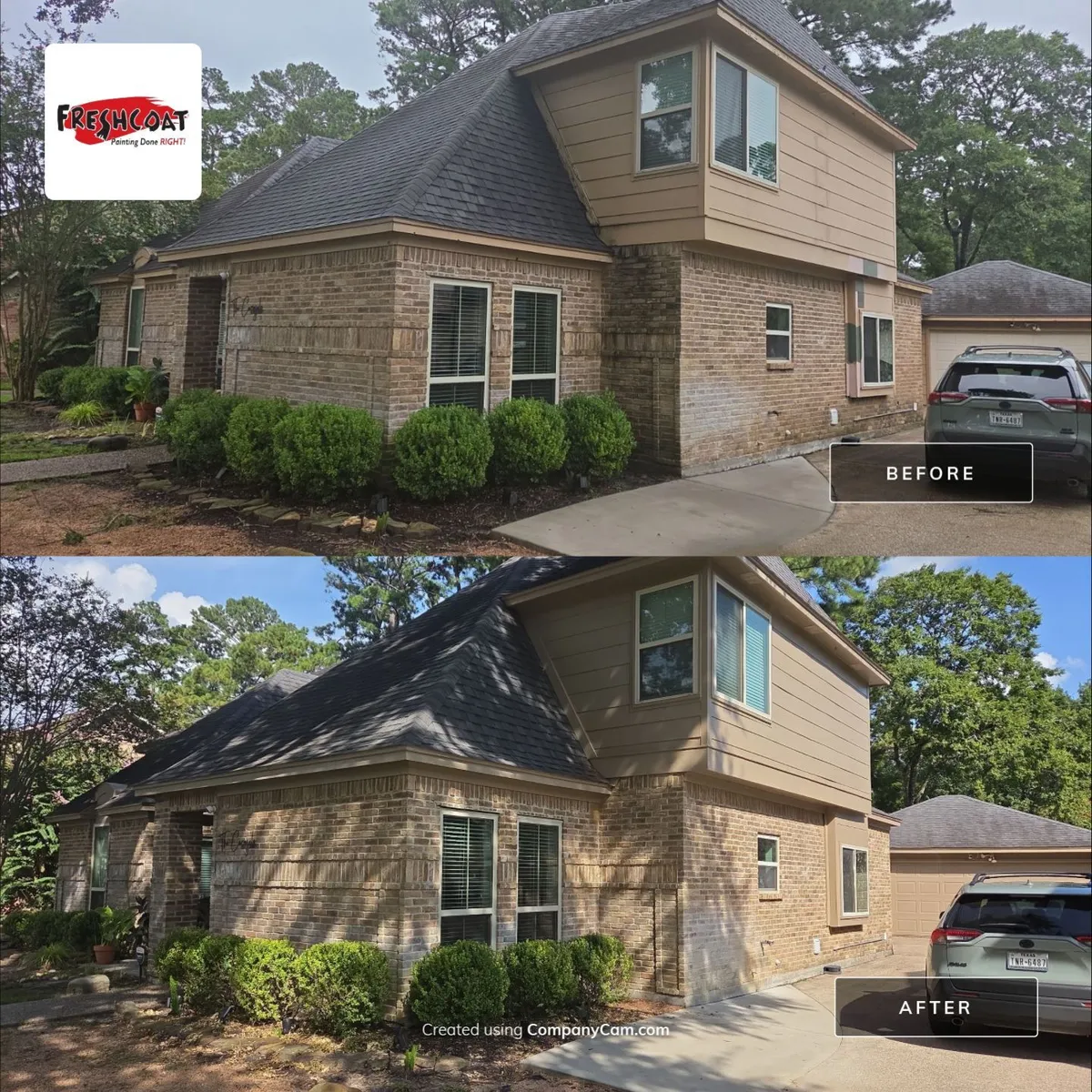
Exterior Paint Peeling & Mildew in The Woodlands TX: Causes
The Short Answer
Exterior paint peels and mildews faster in The Woodlands, TX because of three things stacking on top of each other: humidity that sits at 75-80%+ for most of the year, a UV index that regularly hits 10 or higher from May through September, and a hurricane season (June through November) that drives moisture sideways into every gap in your siding and trim. None of this is a sign your last paint job was done wrong — it's what happens when a paint film built for a drier, milder climate gets asked to survive the Gulf Coast.
I've painted houses in every village of this community, from the original streets of Grogan's Mill to the newer builds going up near Sterling Ridge, and the pattern is consistent. Paint doesn't just wear out here — it gets attacked from multiple directions at once. Here's what's actually happening to your siding, and what holds up against it.
Humidity Is Doing More Damage Than the Sun
The Woodlands averages 75-80%+ relative humidity year-round, and mornings routinely run even higher than that. That matters for two reasons. First, moisture in the air slows paint curing — a coat that should set up in a few hours can take 30-50% longer here, and paint that doesn't fully cure never bonds the way it's supposed to.
Second, that same moisture is exactly what mold and mildew need to establish themselves on a painted surface, along with warmth and something organic to feed on — dust, pollen, tree debris, all of which The Woodlands has in abundance thanks to the tree canopy this community is known for. Mildew doesn't just sit on top of paint. It works into the film and breaks down the binder, which is the same thing holding the paint to your wall. Once that bond weakens, peeling follows — often within a year or two of a repaint that looked fine when it went on.
UV Exposure Bakes the Paint From the Outside
While shaded, humid walls are growing mildew, the sun-facing side of the same house is dealing with a different problem. Houston's UV index regularly hits 10 or higher from May through September, and south- and west-facing walls take the brunt of it. UV rays break down the resins and binders in paint over time, which shows up as fading, chalking, and eventually cracking as the film becomes brittle and loses its flexibility.
So on a single house, you can get mildew staining under the north-facing eaves and UV-driven chalking on the south wall — two completely different failure modes, both traced back to the same climate.
Hurricane Season Pushes Water Behind the Paint
June through November is our highest-risk window for wind-driven rain, and that's a different kind of exposure than a normal rainstorm. Wind doesn't just wet the surface of your siding — it drives water sideways into gaps around trim, fasteners, and window casings. Once moisture gets behind the paint film, it has nowhere to go. The wood or fiber-cement underneath swells, and that swelling pushes the paint off from the back side. That's why homeowners often see peeling concentrate around trim boards and corner joints first, rather than across a flat wall.
This is also why caulking condition matters as much as the paint itself. A coat of premium paint over failing caulk is just delaying the same problem.
Why Some Woodlands Homes Fail Faster Than Others
Age and tree canopy both play a role, and you can see the contrast between neighborhoods pretty clearly. Grogan's Mill is the original village here, developed in the early 1970s, and a lot of that housing stock is approaching or past 50 years old. Original-generation paint systems, older caulk lines, and decades of settling around trim all add up — even a well-maintained older home in that area has more entry points for moisture than a newer build.
Panther Creek sits in between generationally — most of it went up through the 1980s and early 1990s — and it shows a middle-ground version of the same wear pattern: caulk and trim that have been through more heat cycles than a newer build, but without the full 50 years of exposure you see in Grogan's Mill.
Sterling Ridge tells a different story again. Most of that village was built from the late 1990s on, so the structures themselves are newer. But it's also known for dense, mature tree cover, and shade changes the equation regardless of the home's age. Less direct sun means walls stay damp longer after rain, air circulation is reduced, and mildew has more time to establish itself before conditions dry it out. I've painted plenty of 15-year-old homes under heavy tree canopy that needed mildew treatment and prep work you'd expect on a house twice that age.
What Actually Holds Up Here
The fix isn't a specific brand name — it's a combination of the right prep and the right coating system for this specific climate. A few things I won't skip on any exterior job in The Woodlands, TX:
Surfaces get properly cleaned and treated before anything else touches them. Painting over existing mildew, even lightly, just seals it in, and it typically grows back through the new film within a season.
Caulk gets inspected and replaced where it's cracked or pulled away, since that's the entry point for wind-driven rain during hurricane season. And we use 100% acrylic latex coatings with mildewcide built in, rather than oil-based products — acrylic flexes with temperature swings and lets residual moisture escape instead of trapping it under the film.
If you want a full breakdown of what's involved in getting a house ready before paint ever goes on, our exterior painting prep guide covers the process step by step.
On pricing, a typical two-story exterior repaint through Fresh Coat Painters of The Woodlands generally runs in the range of $4,500 to $9,500, depending on square footage, siding material, the amount of trim and prep work needed, and how much mildew remediation or caulk replacement the house requires going in. Homes in older villages like Grogan's Mill sometimes land toward the higher end of that range because of the additional prep, while newer, less weathered homes can come in lower. This is our typical range for premium-grade acrylic coatings applied by dedicated, background-checked crews — not a national average or a bare-minimum quote.
Timing and What's Backing the Work
Exterior paint can be applied in The Woodlands, TX in any season — there isn't a time of year we'd tell a homeowner to avoid. That said, fall and spring tend to be the easiest windows, when humidity dips a bit and temperatures sit in a more moderate range, which can shorten cure times. Summer and winter jobs go fine too; we just adjust scheduling and application windows around temperature and moisture conditions on a given day.
Every exterior job we complete carries a 3-year warranty from us directly, and because we're a Sherwin-Williams Platinum Certified contractor using their premium product lines, the project is also backed by Sherwin-Williams' lifetime warranty after that. I'm also a member of the Painting Contractors Association, and Fresh Coat Painters of The Woodlands is fully licensed and insured — both of those matter more in a climate like this, where the difference between a paint job that lasts three years and one that lasts ten usually comes down to who did the prep work.
Frequently Asked Questions
Why does my exterior paint keep peeling even though I had it repainted recently?
The most common reason is moisture trapped behind the paint film, either from incomplete prep during the last paint job or from wind-driven rain finding its way through gaps in caulk and trim. High humidity during application can also prevent paint from fully curing, which weakens adhesion from the start even if the finished job looked fine.
How can I tell the difference between mildew and dirt on my siding?
A simple test is to dab a small amount of diluted bleach on the discolored area. If it lightens or disappears within a few minutes, it's mildew; ordinary dirt won't react the same way. Mildew also tends to concentrate in shaded, poorly ventilated spots like under eaves or behind landscaping, while dirt buildup is usually more uniform across a wall.
Can I just paint over mildew instead of removing it first?
No. Painting over mildew seals moisture and spores under the new film, and the mildew typically grows back through the paint within a season. The surface needs to be properly cleaned and treated before any primer or paint goes on.
How often should I expect to repaint my house in The Woodlands, TX?
With a quality acrylic coating and proper prep, most homes here go 7 to 10 years between full repaints. Homes with heavy tree cover, north-facing exposure, or older original construction — common in areas like Grogan's Mill — sometimes need attention closer to the 5 to 7 year mark.
What's the best time of year to paint a house exterior in this area?
Fall and spring are generally the easiest windows because humidity is a bit lower and temperatures are more moderate, which helps paint cure evenly. Painting is done year-round here, though, and summer and winter projects are completed successfully with adjusted scheduling around daily temperature and moisture conditions.
What type of paint holds up best against mildew in a humid, shaded climate?
100% acrylic latex paint with a built-in mildewcide additive performs best in this climate. Acrylic stays flexible through temperature swings and allows some moisture vapor to pass through the film rather than trapping it, which reduces both blistering and mildew growth compared to oil-based paint.
Why do shaded or north-facing walls mildew more than sunny walls?
Shaded walls stay damp longer after rain because they get less direct sun to dry them out, and reduced airflow around dense landscaping compounds the problem. Sunny, south- and west-facing walls have the opposite issue — they tend to fade and chalk faster from UV exposure rather than mildewing.
Could hurricane season be part of why my paint is peeling?
It's possible, especially if the peeling is concentrated around trim, fasteners, or corner joints. Wind-driven rain during hurricane season pushes water into small gaps that a normal rainstorm wouldn't reach, and trapped moisture behind the paint film causes the wood or siding underneath to swell and push the paint off from the back.
Are older homes, like the ones in Grogan's Mill, more likely to have paint failure than newer builds?
Generally yes, mainly because of accumulated wear on caulk, trim, and original-generation paint systems rather than the home's age alone. That said, newer homes under heavy tree canopy, like parts of Sterling Ridge, can show similar mildew and peeling issues if shade and moisture exposure are high enough.
Get a Local Read on Your Exterior
If you're seeing peeling, chalking, or mildew staining on a home anywhere in The Woodlands — from 77380 and 77381 to 77382, 77384, 77385, or 77389 — the underlying cause is usually one of the four mechanisms covered above: trapped moisture, UV breakdown, wind-driven rain, or aging caulk and prep. Identifying which one applies determines what prep and coating system will actually last on that specific wall. You can reach Fresh Coat Painters of The Woodlands directly at https://freshcoatpainters.com/locations/the-woodlands/.
— Joe Martinta, Owner, Fresh Coat Painters of The Woodlands